Chinese tallow

Triadica sebifera 路 Euphorbiaceae 路 also Chinese tallow tree, Popcorn tree, Sapium sebiferum

A fast-growing tree (30-40 feet) with heart-shaped leaves that turn brilliant red and yellow in fall and white waxy seeds that look like popcorn on bare winter branches. Those good looks are why it was planted everywhere, and why it is now the worst invasive tree on the Texas coastal prairie, converting grassland and bottomland to single-species thickets. Its sap and fruit are toxic. Sale and distribution are regulated in Texas.
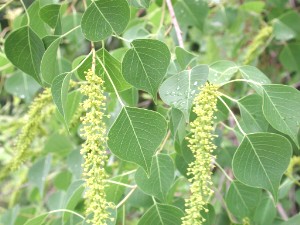
Broadleaf, loses its leaves in winterFast growingSun or part shadeModerate water
Chinese tallow
Pollinator at English Wikipedia, CC BY-SA 3.0, via Wikimedia Commons

Where it stands

Native

This tree evolved here, and local wildlife depends on it.

  • 馃嚚馃嚦 China 路 Native to China and Japan

Invasive

It escapes into natural areas and displaces native plants. Check your state's list before buying one.

  • 馃嚭馃嚫 United States 路 Texas Invasives and NC State report it established in AL, AR, FL, GA, LA, MS, NC, SC and TX, and recently in CAsource
  • 馃嚭馃嚫 FL, United States 路 Florida Department of Agriculture lists it as a noxious weed (Sapium sebiferum), per the USDA National Invasive Species Information Centersource
  • 馃嚭馃嚫 NC, United States 路 Listed as invasive by the NC Invasive Plant Council (per NC State Extension Plant Toolbox)source
  • 馃嚭馃嚫 TX, United States 路 Listed in the Texas Invasives (texasinvasives.org) plant database. Marked as a TDA noxious weed and listed in the Invasive Plant Atlas; range covers the southeastern US from Texas to Florida and North Carolina to Arkansas.source

Prohibited

Selling or planting it is banned here.

  • 馃嚭馃嚫 TX, United States 路 On the Texas Department of Agriculture Noxious and Invasive Plant List (4 TAC 19.300(a)), under both the noxious and invasive headings; Texas regulates the sale, distribution and importation of listed plantssource

Care

Do not plant. It is on the Texas Department of Agriculture noxious and invasive plant list, which prohibits sale and distribution in Texas. Remove existing trees by cutting and immediately painting the stump with a triclopyr or glyphosate herbicide, since cut trees resprout vigorously; pull seedlings when the soil is moist. Replace with native cedar elm, Texas red oak or Mexican plum for fall color.

Benefits

Fall color

Good for

Watch out for

Invasive elsewhereToxic partsMessy fruitSurface roots